« Introducing Howard | Eye Level Home | Designing an Exhibition Gallery »

From A to Z with Andrea Zittel
October 9, 2007

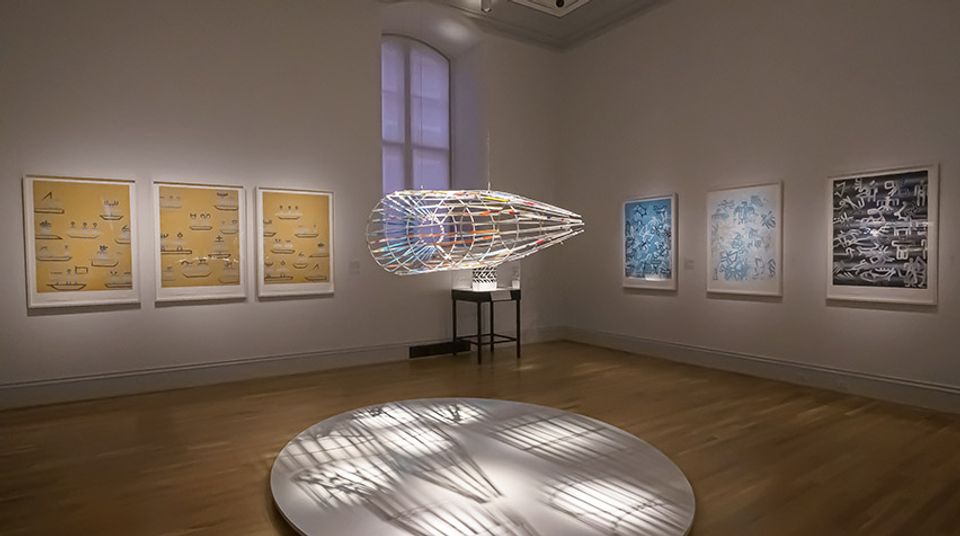
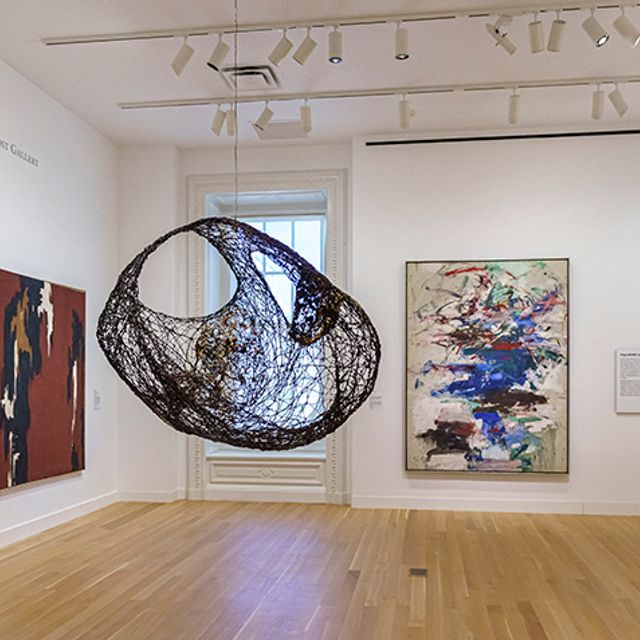
Six of the seven winners of the Lucelia Artist Award have work on view in a special exhibition, Celebrating the Lucelia Artist Award, 2001–2006, on display now. Eye Level caught up with 2005 winner Andrea Zittel while she was at the museum installing A–Z Homestead Office for Lisa Ivorian Gray.

–How much of A–Z Homestead Office for Lisa Ivorian Gray comes with you, and how much of this piece did you acquire at the site?

More of this piece was acquired on site than I usually would. This belongs to somebody and she was using it as her office. But she put her whole office into storage, and I'm trying to simulate that here.

–How does her use compare to how you originally conceived it?

She commissioned this as an office space, so the hard part was to figure out how much of my own habits to impose on her. I sort of forced her into constructions I use myself, like hanging files. I use a kind of sleeve system when I work on projects, so I gave her that same system.

People always talk about how they think these things are really compartmentalized. I'm not really like that—it's more like the fantasy of being like that. It's not like there aren't five heaps of shit on my desk along with this sort of fantasy perfect solution I'm trying to force everything into.

–With a piece like this, do you see the museum as the final destination?

No, it's the use. The shortcoming with my work is always in this context. For years I struggled with that, and then at some point I realized, it is a shortcoming. In a way I'm glad that the work is ultimately destined for the world.

Smocks

Smocks from Andrea Zittel's Smockshop

–I understand you've designed some new clothing?

I've been doing clothes the whole time—I've done uniforms. I've made this pattern, I call it a smock. I've started a smock shop in LA; it's a business enterprise to hire young artists. So we started sewing smocks and selling them at affordable prices.

–So these are young designers?

They're artists. I started this because, when I teach, I feel like I'm pushing my students toward more and more ephemeralized, noncommercial, even conformative practices. In the back of my mind I wonder how someone does that kind of work and earns a living. I end up hiring a lot of them and we end up talking about different kinds of work structures and what works. So we're trying to find a business that would sustain their practices—something where, when they need money, they would have work, but when they don't need money or have to do a show, they don't. It had to be a really specific structure. It's not like you can say, "Okay, come work at my studio every Tuesday and Thursday from 10 to 6," because that's not fluid enough. So working on the dresses works really well for them. It's a two-fold thing: creating that kind of structure but also trying to extend this uniform system. A lot of sewers are now wearing the uniforms.

–You think it's important that artists are given complete license to do their work but also to do it in a way that's very practical?

I think it's a real issue in the art world. It's become so commercial, and everyone agrees that it's commercial, but there aren't any alternatives to that. I think it's funny that the alternatives to the commercial that exist are actually blatantly commercial. It's so commercial that it's trying to create a space where they can do work that's extremely noncommercial.

I've always had a love-hate relationship with the fashion world—more like a hate-hate relationship. So I've tried to go into it and make fashion that's not corrupt.

–Why is this based out of LA and not New York?

It's hard because right now a lot of the sewers are moving to New York, so we've been trying to talk about what to do. We did a show that's in Chelsea right now, but our sewing studio is in LA. I don't know if we'll go back and forth or they'll sew here and send to us there. A nice outcome of being on both coasts is that a lot of people who don't know each other become friends. They make a support community. It is really nice to have people work together. We do this thing called a Friday review where everyone brings in the dresses they've made and show them to the group, and through that, a lot of them have become friends. I feel that the community aspect is important.

–Why do you think sewers are moving to New York?

It's a lot of young LA artists who want to move to New York to see what that's like. Most of my friends who are artists go back and forth. Jim and I were laughing because they move to New York and they think it's for two or three years, but when they move back to LA they miss New York. So you're sort of cursed once you do it. You can never quite do one or the other.

–Is that your own experience?

Yeah. I was so excited to move back home to California, but I always miss New York.

–Your work has never been centered in either city.

It is in Joshua Tree.

Seeing your piece next to Rirkrit Tiravanija's piece is interesting—they rhyme.

Yeah—we're both using corrugated steel, and the cherry looks a lot like his mahagony. The art has all these formal overlaps.

–When you got the Lucelia award, did you know right away what you would do with it?

I knew right away. I hope people aren't offended, but where I live [in Joshua Tree] I had no well, and all my water got trucked in. So I used that money to put in a well! I guess I should have spent it on my art, and I think in an indirect way I did.

–What are the things at Joshua Tree you're working on right now?

The thing I'm working on, the Wagon Stations, and then . . . I always think out loud and then wish I hadn't. I'm looking to find out whether there's a way to turn my land into a foundation. I have thirty acres; I have a house. It's half a mile from the highway, so it's pretty accessible. All my land backs up to [Bureau of Land Management] land. So it's a really good public space, but it's hard to have a private life there, especially because people know where I am. I find that people are always coming up there, so what I want to find out in the next five years is whether there's a way to roll that over into something that's self-running and something that would be more like a foundation artists could come and use.

–So people come and visit you there?

Yes, and that's really, really great. I'd say that when I'm there, at least once a week someone new will come by and visit. But a lot of times people will come off the highway, and I come out in my pajamas and there are people in the yard looking at the Wagon Stations. That gets a little oppressive. What I want to do this year is find out the viability of doing something like that. I should talk to the guys at CLUI.

–What is a significant problem you face in executing your work?

Just right now I feel like there are all these . . . it comes back to that question of, does the work function here? And there are a lot of things I feel like I can do that push the boundaries of art or at least change its circumstances but I find it hard to make them work in an exhibition context. For me, that's super frustrating. I'm getting ready to do a few gallery shows and I'm worried about how to translate all this stuff that works really really well outside into the gallery.

–Ultimately, does art have to come back to the gallery?

That's a good question. Maybe that question is part of the answer. I'll be really curious to see what happens in the art market. There's been this real inflexibility. The art market has been on steroids for the last six or seven years or so, and I don't think that galleries have been willing to have the flexibility to try experimental shows. I just remember the last time things took a dive, they were really willing to take more risks that way. I came into the art world at around that time, and it was so fun.

–You're a person who works with a lot of young artists. What do you think this market has meant for their work?

A lot of the artists who I've worked with are starting to get shows over the past year. They're not highly commercial artists but they're doing okay. I'm thinking of Murray Lawrence. Most of the artists I'm working with are not doing very commercial work, so they're all living on the fringes.

When you go into Chelsea and you see those big galleries, you think that's the art world. But there's this other huge art world where people are working and even having critical success. They're not in the Artforum ads, but they find an audience through Artpace, through Creative Time, through these other kinds of public spaces.


Posted by Kriston on October 9, 2007 in American Art Here


Comments

Does anyone know where or how I could find the pattern for Andrea Zittell's smock dress? I can't find an email address anywhere for her.

Posted by: Adele | Nov 29, 2007

Andrea Zittel is such a fascinating artist! I had never heard about her, but decided to check out her show at LA MoCA after reading a write up of the show on JuliB.com, and was frankly just blown away.

Posted by: Rachel H | Jan 6, 2008


Post a comment

Lively discussions and different opinions are encouraged. Questionable language, off-topic comments, and flames will either be edited or deleted. Comments are moderated and will not appear on Eye Level until they have been approved.

If you have a TypeKey or TypePad account, please Sign In