Robert Motherwell’s Monster for Charles Ives
July 2, 2009
Robert Motherwell's Monster (for Charles Ives)
Robert Motherwell, known as an intellectual painter, has sometimes been called the spokesperson for the abstract expressionist movement. He painted in a style that often involved spontaneously generated images on large fields of canvas. Fifty years ago, in 1959, he created Monster (for Charles Ives). It has a white circle slightly off center that looks like a porthole on a ship looking into fog.
As the title suggests, a hulking animal, made up of brown brushwork on a dirty white ground, looms. The composition is reminiscent of Motherwell's previous interpretations of Francisco Goya’s The Dog. At the time of the painting, Motherwell was listening to a festival of music by avant-garde composer Charles Ives on radio station WBAI in New York. Motherwell remarked that his painting expressed the difficulties faced by the American artist. “I dedicated the painting to Ives, for the title refers to the monstrous ambiguity of the modernist artist’s situation, which Ives no less (and no more) epitomizes than other deeply serious composers, poet, playwrights, painters and sculptors in the U.S.A. in the twentieth century."
Motherwell was perhaps the most "political" of the abstract expressionists and did not shy away from social commentary. His painting series "Elegies to the Spanish Republic" delves into the Spanish Civil War (1936–1939). (See paintings from this series in the Metropolitan, the MoMA, and the Guggenheim.) I admire Motherwell for not turning away from war and other miseries, and for showing us the light that emerges out of darkness. "Monsters occur more often in my work than may be supposed," Motherwell said as well. That quote has made me take a closer, deeper look at Motherwell's work, in case I may have missed something.
Not all monsters are the kind lurking under the stairs. Some are right in front of you. The trick is to find them before they find you.
Check out more artworks in our collection by Robert Motherwell and explore our online exhibition Modernism and Abstraction for a survey of other artists. You can find related books in our online shop: Modernism and Abstraction: Treasures from the Smithsonian American Art Museum and Modern Masters: American Abstraction at Midcentury.
- Robert Motherwell, Charles Ives, Abstract Expressionism, Modernism, American Art,
Smithsonian American Art Museum
Posted by Howard on July 2, 2009 in American Art Here
Permalink
| Comments (0)
In this Case: More 1934 in the Luce Foundation Center
June 25, 2009
Waterfront—Brooklyn by Harry Shokler
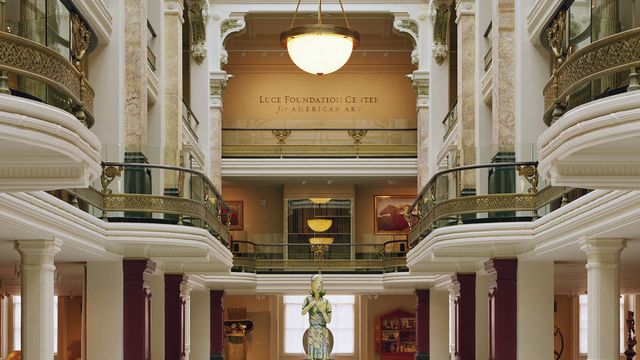
It was August last year when visitors on my tour started to pause a bit longer in front of cases 34b to 38a. All of a sudden the public’s interest was piqued by these paintings of industry, a hard day’s work, and the American heartland. Now almost a year on, recent economic events have brought these pictures of the "American Scene" from the 1930s sharply into focus. Many of those paintings originally shown in the Luce Foundation Center now feature in the exhibition 1934: A New Deal for Artists, currently on display at the American Art Museum. The show focuses on the Public Works of Art Project (PWAP), a government program that supported artists from December 1933 to June 1934 during the Great Depression.
The exhibition is timely but also, I think, notable for being drawn entirely from the American Art Museum’s permanent collection. This is why I would like to point you back to the Luce Foundation Center, our visible storage center, where there are twelve more paintings from the PWAP on view. The museum has great depth in this area, meaning that the Luce Center has been able to replace the departing paintings with more works from storage. If you’ve enjoyed 1934: A New Deal for Artists at the museum or online, then I suggest coming up to the Luce Foundation Center to see more.
Among the highlights is Waterfront—Brooklyn, a harbor snow scene showing the perpetual movement of workers, cranes, boats, smoke, and trams. In the background, the great skyscrapers of Manhattan signal recent achievements, and in the foreground the homey Majestic Diner beckons—the reward at the end of the working day. In addition to the twelve paintings from 1934, the Luce Center has works created for the Federal Art Project (FAP), which ran from 1935 to 1943. This last program includes our collection of mural studies for public buildings across America. Seeing these paintings next to each other is a great way to appreciate the influence of federal art programs and is a sure way to introduce yourself to some fascinating new artists.
The catalogue for 1934: A New Deal for Artists will be available this summer.
- 1934, Harry Shockler, Luce Foundation Center, Public Works of Art Project, American Art,
Smithsonian American Art Museum
Posted by Edward on June 25, 2009 in American Art Here
Permalink
| Comments (0)
In This Case: Death of Rubén Salazar
June 23, 2009
Frank Romero's Death of Rubén Salazar
As the saying goes, beauty is in the eye of the beholder. Similarly, in the Luce Foundation Center, our staff members have an array of "favorites." Bridget loves folk art, Ed enjoys our new Fairfield Porter (new to Luce, not the museum), and Georgina loves the Roman glass vessels and everything technology related. I am attracted to pieces that embody my passion for Spanish language and Latino culture. Frank Romero's Death of Rubén Salazar is just one example of our diverse collection of Latino art in the Luce Foundation Center.
Frank Romero emerged as an important Chicano artist in Los Angeles during the 1960s. The word Chicano generally refers to Americans of Mexican descent. It became a more general cultural term during the Chicano Movement in the 1960 and 70s, which addressed social inequality and negative stereotypes of Mexican Americans. During that time, Romero was part of an artistic circle called Los Four that created large murals that often expressed pride in their Aztlán, or Aztec, heritage. They also created murals in response to political events like the farm workers protests, the Vietnam War, and discrimination against minorities in Los Angeles.
Death of Rubén Salazar is an example of Romero's later work that portrays political and civil unrest. The painting's vivid imagery virtually overwhelms the viewer; the contrast of the bright colors and short brush strokes make it hard for viewers to rest their eyes. The painting's large scale and colors are deceiving. At first glance, one might think it portrays a happy scene. The painting, however, depicts the tragic death of Rubén Salazar, a civil rights activist and journalist for the Los Angeles Times. After covering a peaceful antiwar protest in 1970, Salazar was struck and killed by a tear gas canister fired by the police. Although the canvas was painted sixteen years later, it indicates Romero was still greatly affected by the event. You can hear Frank Romero talk about Death of Rubén Salazar in this video.
Check out other Latino artists in our online exhibit. If the subject matter of this artwork interests you, you might also like Consuelo Underwood's piece in the Luce Foundation Center, Virgen de los Caminos.
Como el dicho la belleza depende del ojo con el que se mira, cada persona que trabaja en el Luce Foundation Center tiene sus propios gustos. A Bridget le encanta el arte folclórico, a Ed le gusta el nuevo cuadro de Fairfield Porter (obra nueva en el Luce, aunque ya formaba parte de la colección del museo) y a Georgina le encantan los recipientes romanos y todo lo que tiene que ver con la tecnología. A mí me atraen los objetos que expresan mi pasión por el castellano y la cultura latina. Death of Rubén Salazar es uno de los ejemplares de nuestra diversa colección de arte latino en el Luce Foundation Center.
Frank Romero se convirtió en importante artista chicano en Los Angeles durante los años 60. La palabra chicano se refiere generalmente a americanos de linaje mexicano. Se convirtió a un término cultural más general durante el movimiento chicano en los años 60 y 70 que luchó contra la injusticia social y estereotipos negativos de los americanos de linaje mexicano. Durante esta época, Romero era parte de un c írculo art ístico que se llamaba Los Four que hac ía murales que mostraban su orgullo de ser de linaje azlán, o azteca. El grupo también hac ía murales que trataban tanto de los eventos pol íticos como las protestas de los agricultores, la guerra en Vietnam y la discrimación hacia gente de la minor ía en Los Angeles.
Death of Rubén Salazar es un ejemplo más reciente en la obra de Romero que muestra tensiones sociales y pol íticas. El cuadro le inunda; el contraste de los colores brillantes y los brochazos cortos hace dif ícil enfocar el ojo. La escala grande y los colores le engañan. Al principio, se puede pensar que el cuadro se trata de una escena alegre. En realidad la pintura representa la muerte trag íca de Rubén Salazar, un activista social y periodista por el Los Angeles Times. Después de informar sobre una protesta pacifica contra la guerra, la polic ía pegó a Salazar con un bote de gas lacrimógeno que provocó su muerte. Aunque Romero pintó este cuadro dieciseis años después de la muerte de Salazar, está claro que el suceso le afectaba todav ía. Se puede escuchar a Frank Romero hablando sobre el Death of Rubén Salazar en este video.
Lea más sobre otros artistas latinos en nuestra exposición en la red. Si le interesa el tema de este cuadro, quizás le guste Virgen de los Camino por Consuelo Underwood que está también en el Luce Foundation Center.
Posted by Tierney on June 23, 2009 in American Art Here
Permalink
| Comments (0)
Looking at 1934: Lily Furedi's Subway
June 18, 2009
Lily Furedi's Subway, part of the exhibition 1934: A New Deal for Artists
The other day while taking the Metro (that's D.C.-speak for subway) to the Smithsonian, I spotted something on the floor below the seat across from me. When I got up at my stop, I took a closer look and noticed that it was a little two-sided brush. Too small for even the smallest artist (though I recently learned that Mughal miniaturists often used a brush made of no more than one or two squirrel hairs), it was a brush for applying makeup—some blush or eyeliner, perhaps? Throw in a little lipstick, and that's pretty much as far as my makeup vocabulary will take me.
Growing up in Brooklyn, and later on, attending grad school in Manhattan, I became something of a connoisseur of the subway. I'm sure all New Yorkers (even those who've left) feel that. As a young person, the subway meant freedom. Getting older and heading to school and work, however, it meant rush-hour crowds, stifling hot platforms in summer, and enough crowded cars to make even the most tightly packed sardines feel free-range.
Often on the subway, there would be a woman applying her makeup right there on the train. I always thought it was magic to watch this rite performed in public, usually done in a hurry. As an experienced subway observer, you look but kind of don't look at the same time. Call it Subway 101.
In Lily Furedi's homage to the New York subway, part of the current exhibition 1934: A New Deal for Artists, I'm captivated mostly by the woman applying lipstick on the far left—so much that I want to create a narrative for her. Unlike most of the other women in the car, she doesn't wear a hat, but rather wears her hair in a style Martha Graham often wore, called "squash blossom." (Graham copied this style from American Indian women she met in the Southwest.) It also reminds me of Princess Leah at the same time. I wonder then, is the woman in the painting a dancer on her way to rehearsal, or perhaps a performance? This I do know: Martha Graham and her contemporaries were as much products of the times as were the visual artists represented in 1934. Dancers responded to the challenges of the day through movement, turning the art form on its head.
But here's the rub: when Martha Graham talked about those times, she said that after a rehearsal uptown, she had to choose between buying lunch and taking public transportation back to her apartment in the Village. She always chose lunch. Unable to afford both, she walked back home. So perhaps the woman in Furedi's painting is not a dancer. Maybe she's about to get off at the next stop and enter an office, the theater, or meet up with a date. Hopefully, she won't drop anything on the floor...
Related Material:
1934: A New Deal For Artists exhibition slide show
Add your own images from 1934 to American Art's Flickr group
Posted by Howard on June 18, 2009 in American Art Here
Permalink
| Comments (6)
Portraits of Women Artists
June 16, 2009
Women Artist Portraits, part of American Art's Juley Collection on Flickr Commons
To celebrate Women’s History Month, a selection of women artist portraits from the Peter A. Juley & Son Collection, part of the photograph archives at the American Art Museum, was added to Flickr in March.
Peter A. Juley (1862–1937) and his son Paul P. Juley (1890–1975) headed the largest and most respected fine arts photography firm in New York. Between 1896 and 1975, the Juleys photographed hundreds of thousands of artworks and many artists. The American Art Museum acquired the firm's photographic negatives in 1975. Most of the 127,000 negatives are pictures of artworks, but nearly 4,700 are portraits of artists: some in formal poses, some candid; some at work in their studios, at home, or teaching classes.
A few sculptors illustrate the wide variety of personalities and portrait styles. For example, Selma Burke poses next to a clay bust while wearing a black dress and a multistrand necklace. Margaret French Cresson, also in a “dressed-up” pose, holds a tool of her trade: a wire-end clay modeling tool. In a seemingly candid, informal shot, Helene Sardeau has clay-stained hands and coveralls.
Other portraits are more formal and traditional, like those of Peggy Bacon, Isabel Bishop, and Theresa Bernstein, who died in 2002, just shy of her 112th birthday. And then there is the photo of Bianca Todd, wherein she evokes the image of a child playing dress-up. Was she really so dramatic and fun? (See more images of Bianca Todd.)
Many of these pictures also offer unique views of works-in-progress. We see Aline H. Rhonie standing on scaffolding in front of her aviation mural at Roosevelt Field in Garden City, New York. Countess Maria Zichy poses beside her portrait of Benjamin Franklin. And Gwen Lux works on a model for one of her sculptures that was later shown at the Third Sculpture International exhibition in Philadelphia in 1949.
It is easy to take for granted the proliferation of art images available to us today—on the Internet, museum Web sites, and community sharing sites like Flickr. It is now easier than ever to take our own photographs with digital cameras or cell phones and post them online immediately. But that wasn’t the case a hundred years ago. In the early twentieth century, when cameras were not as portable and reproduction was costly, photos of art were much harder to come by. Thankfully, Peter A. Juley & Son devoted itself almost entirely to fine art photography, and today those pictures of artists and artworks remain relevant for art historical research as well as for our viewing pleasure. I hope you enjoy these portraits as much as I do.
- Peter A. Juley & Son Collection, Photography, Artist Portraits, Women's History Month,
Flickr Commons, American Art, Smithsonian American Art Museum
Posted by Nicole on June 16, 2009 in Picture This
Permalink
| Comments (3)


Recent Comments